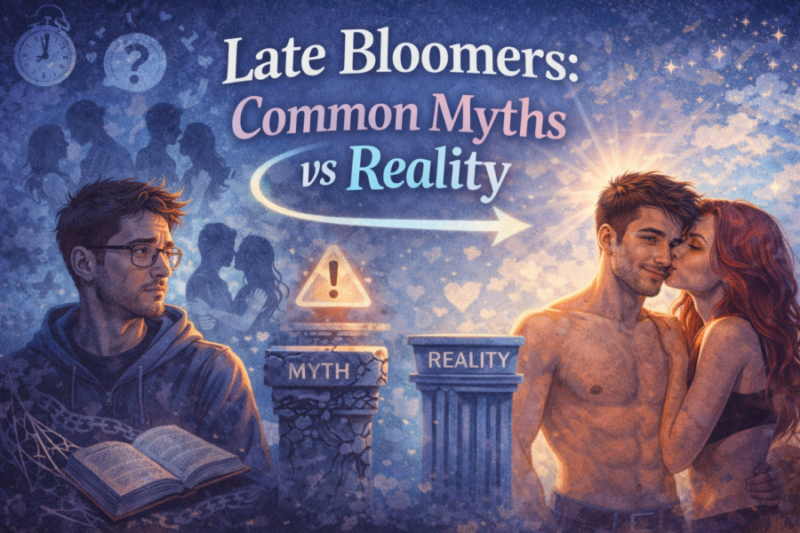
Late Bloomers: Common Myths vs Reality
TLDR
- Late bloomers are far more common than people assume, and they don’t signal dysfunction
- Sexual and relational timing varies widely due to psychology, upbringing, and opportunity
- Lack of early experience does not permanently damage attraction, performance, or bonding ability
- Confidence grows from exposure and learning, not from teenage milestones
- Adult starters often build healthier relationships because they’re more intentional
If you grew up believing life followed a strict timeline, you probably carry a quiet suspicion that you missed something important.
First kiss in high school. Dating in college. Sexual confidence in your twenties.
Then you look around, notice how casually other people talk about these experiences, and it feels like everyone received instructions you never got.
Working on this site, I’ve spoken to hundreds of men in their mid-20s, 30s, even 40s who share the same private question: Did I permanently mess up my development by starting late?
Let’s separate the stories people tell from what actually happens in the real world.
Myth 1: “Late Bloomers Are Rare”
The internet exaggerates early development because confident people talk more. Those who start later usually stay quiet, which creates a distorted baseline.
Human sexual development is not a synchronized process. It depends on social exposure, personality traits, mental health, family norms, religious environment, peer group, and opportunity. Change one of those and the timeline shifts.
Men who were introverted, academically focused, isolated geographically, bullied, anxious, depressed, or simply late physically often begin years after peers. Not because they are broken, but because experience requires circumstances.
When those circumstances finally appear, development begins.
In other words, the clock didn’t stop. It just hadn’t started yet.
Myth 2: “If It Didn’t Happen Young, It Won’t Feel Natural Later”
Many late starters worry intimacy will always feel mechanical. They expect permanent awkwardness.
That assumption misunderstands how sexual learning works.
Human sexuality is adaptive learning, not imprinting. The brain forms associations through repetition, reward, comfort, and emotional safety. Adults do this just as effectively as teenagers, often more effectively because attention and communication are better.
In practice, the first experiences feel unfamiliar because they are unfamiliar. After exposure, the nervous system calibrates quickly. A pattern emerges: anticipation, response, adjustment, comfort.
The body learns faster than the imagination fears.
Myth 3: “Partners Can Always Tell You’re Inexperienced”
People imagine experience is obvious, like a visible label. It rarely works that way.
What partners notice is tension, avoidance, and self-consciousness. Those signals come from anxiety, not lack of history.
Someone who asks questions, responds, and stays present reads as attentive. Someone who overperforms or freezes reads as nervous. Experience does not guarantee comfort, and lack of experience does not guarantee awkwardness.
I’ve personally heard women describe first encounters with confident virgins as relaxed and enjoyable, and encounters with highly experienced partners as detached and uncomfortable.
Behavior matters more than biography.
Myth 4: “You Missed the Window to Develop Confidence”
Confidence is often mistaken for accumulated victories. In reality, it comes from familiarity.
Teenagers don’t become confident because they succeed. They become confident because they repeatedly enter situations that stop feeling unknown.
A late bloomer simply compresses that exposure into adulthood.
The brain handles this perfectly well. Social learning continues across the lifespan. New environments, careers, friendships, and skills are learned in adulthood constantly. Dating and sexuality follow the same principles: predictability reduces anxiety.
After a handful of real experiences, most men stop feeling “behind” and start feeling “current.”
Myth 5: “Late Starters Perform Worse Sexually”
Performance anxiety is common among inexperienced men, but it’s not unique to them. It is one of the most frequent sexual issues across all experience levels.
Physiological response depends heavily on relaxation and attention. Overthinking interrupts arousal, while presence supports it. This is why some highly experienced men still struggle and some first-timers don’t.
Sexual competence grows through feedback and communication. Adults are actually better positioned for this because they can talk openly, notice patterns, and adjust intentionally.
Skill is learned behavior, not a teenage achievement badge.
Myth 6: “Women Expect Expertise”
Most adults are not evaluating technical mastery. They’re evaluating comfort, respect, and responsiveness.
People want to feel chosen and understood. That comes from paying attention, not from rehearsed performance.
A man who listens, adapts, and stays relaxed usually creates a positive experience even if it’s his first few times. A man who treats intimacy like an exam often creates tension even if he has a long history.
Expectations are emotional, not athletic.
Myth 7: “You’re Emotionally Stunted”
This one hits hard because it sounds psychological.
But emotional maturity and sexual history are separate developmental tracks. Many men delay dating because they’re thoughtful, cautious, or focused elsewhere. Those traits often correlate with better relationship stability later.
Late bloomers frequently enter relationships with clearer boundaries, more empathy, and less impulsivity than people who dated constantly during identity-forming years.
You didn’t pause emotional growth. You just grew in a different environment.
Myth 8: “The First Relationship Will Be Doomed”
Actually, late relationships often progress slowly and intentionally. That reduces volatility.
You’re not experimenting with identity at the same time you’re learning attachment. You already know your routines, preferences, and values. That stability makes communication easier.
Early relationships often collapse because both people are figuring themselves out. Adult starters usually negotiate rather than react.
Different start, different dynamics.
Myth 9: “You Need to Catch Up Fast”
This belief creates the most damage.
Rushing produces poor partner selection, emotional overwhelm, and avoidable negative experiences. The goal isn’t to compress ten years into one year. The goal is to become comfortable interacting naturally.
A steady pace works better. One conversation, one date, one step beyond the last comfort zone. The brain prefers gradual exposure. Confidence compounds quietly.
You’re not behind a race. You’re building familiarity.
What Actually Changes When You Start
There’s a consistent progression most late bloomers report:
First, anxiety drops after the first real mutual interest.
Then curiosity replaces fear.
Then self-consciousness fades during physical closeness.
Then preferences appear.
The most surprising shift is identity. Many men don’t suddenly become different people. Instead, they feel oddly normal, as if a background noise turned off.
I remember a reader describing his first relationship at 33 as “anticlimactic in the best possible way.” He expected transformation and got integration. Life stayed the same, just less tense.
That pattern repeats constantly.
Why Late Bloomers Often Do Well Long Term
Starting later removes some distortions common in early dating:
You’re less influenced by peer pressure
You’re less motivated by status
You communicate more directly
You notice compatibility sooner
Because intimacy wasn’t automatic in youth, you tend to appreciate it consciously. That changes partner choice and behavior in subtle but powerful ways.
Experience quantity doesn’t equal relational quality. Awareness does.
A Healthier Perspective
The biggest shift is reframing timing.
Human development is not a school curriculum where missing a semester blocks graduation. It’s exposure-based adaptation. When exposure begins, development begins.
Late bloomers don’t repair a broken system. They activate a dormant one.
Your story doesn’t start late. It starts when it becomes relevant to your life.
Conclusion
Most fears around late blooming come from imagined permanence. The idea that certain doors close after a certain age.
But intimacy is not a youth-only skill. It’s a human skill. It responds to attention, comfort, and repetition at any adult stage.
You don’t need to erase the past or compensate for it. You just need enough new experiences for the unfamiliar to become familiar.
And that threshold arrives much sooner than most people expect.