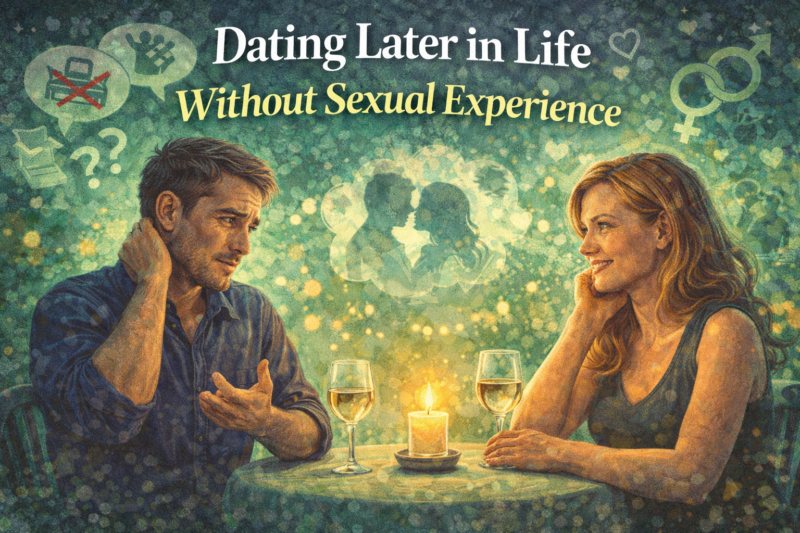
Dating Later in Life Without Sexual Experience
TLDR
- Dating later in life without sexual experience is more common than many men assume
- Social anxiety and performance anxiety are modifiable and respond well to gradual exposure
- Emotional intelligence and communication skills matter more than sexual history
- Honest, well-timed disclosure builds trust and reduces pressure
- Sexual competence is a learned skill that develops through experience, not age alone
Dating in your late 20s, 30s, or beyond without sexual experience can feel like you’re carrying a secret.
You sit across from someone interesting, funny, attractive, and there’s a quiet voice in your head saying, “If she knew, this would be over.”
That voice is powerful. It can shape your posture, your tone, even how much eye contact you make.
But here’s something important: sexual experience is not a prerequisite for being dateable. It’s a skill set you develop, not a membership card you either earned at 19 or lost forever.
Let’s talk honestly about what this phase requires and what actually matters.
You’re Not as Rare as You Think
Population research consistently shows wide variation in the age at which people begin sexual activity. While many individuals become sexually active in late adolescence or early adulthood, a meaningful minority do not.
Some delay for religious reasons. Some due to social anxiety. Some because of limited opportunity, health issues, or simply different life priorities.
Cultural narratives exaggerate uniformity. Real life is messier.
Feeling alone in this experience is common. Actually being alone in it is less common than you assume.
The Real Barrier Is Often Anxiety
When men describe difficulty dating later in life without experience, anxiety usually sits at the center.
Social anxiety increases self-monitoring. You become hyper-aware of how you’re coming across. That self-focus can make interactions feel stiff or rehearsed.
Performance anxiety, especially once intimacy seems possible, adds another layer. Research consistently shows that anticipatory anxiety can interfere with sexual arousal and erectile function.
The irony is that fear of inexperience often creates the very awkwardness you’re trying to avoid.
Anxiety is treatable. Gradual exposure to social situations, cognitive restructuring, and in some cases therapy, have strong evidence behind them.
This is a skill gap, not a permanent identity.
Sexual Experience Is Not the Same as Sexual Skill
There’s an assumption that experience automatically equals competence.
That’s not always true.
Long-term sexual satisfaction is strongly associated with communication, responsiveness, and emotional attunement. Those are relational skills, not mileage counters.
Someone can have many partners and still lack empathy or listening ability. Someone with limited experience can be attentive, curious, and collaborative.
Sexual competence develops through feedback and openness. Age does not determine your capacity to learn.
The Importance of Emotional Intelligence
Emotional intelligence predicts relationship satisfaction more reliably than sexual history.
Being able to regulate your emotions, read social cues, and communicate clearly builds attraction and stability. These traits are learnable.
If you’ve spent years developing your career, managing responsibilities, or working on personal growth, you likely have strengths that younger versions of yourself didn’t.
Those strengths matter in dating.
Attraction is multidimensional. Stability, kindness, humor, and integrity consistently rank high in partner preferences across studies.
When and How to Disclose
One of the biggest questions is disclosure.
You do not need to announce your sexual history on the first date. Disclosure tends to work best once mutual interest and trust are established, but before sexual intimacy escalates to the point of confusion or pressure.
Research on self-disclosure shows that gradual, appropriate vulnerability strengthens connection.
Keep it simple. You can say that your sexual experience started later than average and that you’re still building experience. Tone matters more than detail.
If you speak with calm self-respect, most people will respond in kind.
Managing Your Own Narrative
If you frame yourself as broken, others may unconsciously adopt that frame.
If you frame yourself as someone who developed at a different pace and is now actively engaging, the story changes.
Confidence is not pretending you know everything. It’s being grounded in who you are while still learning.
I’ve noticed that men who own their story without dramatizing it tend to move through dating with less friction.
You don’t need to apologize for your timeline.
Physical Intimacy: Go Gradually
When physical intimacy becomes part of the picture, pacing helps.
There is strong evidence that anxiety interferes with arousal. Taking pressure off immediate performance allows your nervous system to remain calmer.
Focus first on comfort with touch, kissing, and non-sexual physical closeness. Build familiarity before escalating.
Communication during intimacy increases satisfaction for both partners. Asking what feels good, expressing what you enjoy, and staying present reduces guesswork.
You’re not expected to deliver a flawless performance. You’re expected to participate.
Rejection and Resilience
Dating involves rejection for everyone.
It’s tempting to attribute any rejection to lack of sexual experience. In reality, compatibility depends on many factors: timing, personality fit, life goals, chemistry.
Research on resilience shows that interpreting rejection as specific rather than global protects self-esteem.
If someone isn’t interested, that reflects a mismatch, not a universal verdict on your worth.
Building resilience is part of dating at any stage.
Practical Steps That Help
There are practical ways to strengthen your position.
Improve sleep and physical health. Exercise is associated with improved mood and self-esteem. Well-fitting clothes and basic grooming influence first impressions.
Expand social exposure gradually. Join interest-based groups. Practice small conversations. The goal is repetition, not perfection.
If anxiety feels overwhelming, therapy focused on cognitive-behavioral strategies has strong empirical support.
These are controllable variables.
You Are Not Competing With a Fantasy
It’s easy to imagine that every other man your age has a flawless romantic history.
That’s rarely accurate.
Many people carry complicated pasts: painful breakups, sexual dysfunction, attachment wounds, unresolved trauma. Experience does not equal ease.
In some cases, starting later means you approach relationships with more intention and less chaos.
That can be an advantage.
A Personal Reflection
Over time, I’ve seen something consistent.
Men who begin dating later often approach it thoughtfully. They ask better questions. They value stability. They are less interested in games.
Those qualities create durable connections.
Yes, there may be awkward moments. But awkwardness is part of learning anything new.
What matters is momentum.
Conclusion
Dating later in life without sexual experience is not a verdict on your desirability.
It is a starting point.
Anxiety can be managed. Sexual skills can be learned. Communication and emotional intelligence carry more weight than history.
Be honest at the right time. Move gradually. Stay steady in your self-respect.
Your timeline may be different, but different does not mean deficient.