🧩How to Deal With Performance Anxiety Before Sex

TLDR
- Stress Response: Performance anxiety is a common psychological reaction linked to stress and self-evaluation.
- Fight-or-Flight: The body’s nervous system can interfere with arousal and erection quality when it feels under pressure.
- Sensory Shift: Moving attention from “performance” to physical sensation reduces pressure.
- Communication: Being honest with a partner lowers internal tension and increases emotional safety.
- Practical Tools: Techniques like controlled breathing and reframing “success” help reduce symptoms over time.
Performance anxiety before sex is far more common than people usually admit. It tends to sit quietly in the background, building pressure long before anything physical even happens.
For many men, especially those who feel they started later than their peers, it can feel like an invisible test they are expected to pass. This is a common hurdle during a late sexual awakening.
What makes it tricky is that it rarely comes from the body itself. It comes from interpretation. This involves the meaning you attach to the moment, your partner’s expectations, and your own internal standards.
Once the mind starts monitoring instead of experiencing, tension follows quickly. Understanding that shift is the first step to loosening its grip and building adult sexual confidence.
🛑 What Performance Anxiety Actually Is
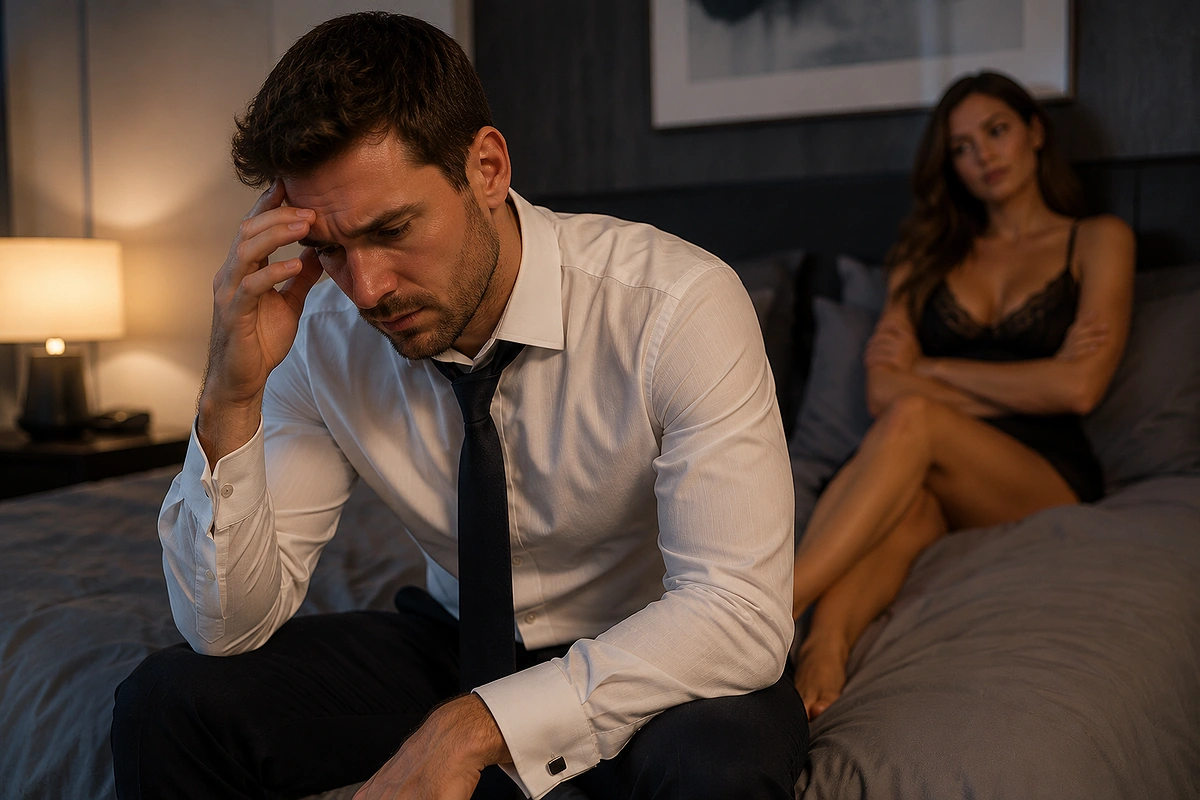
At its core, performance anxiety male symptoms are a stress response. Your nervous system does not distinguish between a job interview, a public speech, or a sexual encounter where you feel evaluated. If it senses pressure, it activates the same physiological pathway. This often triggers psychological barriers to sexual expression that can feel overwhelming.
Shutterstock
That means increased adrenaline, tighter muscles, and a faster heart rate. In practical terms, this can lead to temporary issues with erectile function. The important part here is that nothing is “broken.” Your body is doing exactly what it is designed to do under perceived pressure. The issue is the perception, not the mechanism.
| Feature | The Evaluation State | The Arousal State |
| Nervous System | Sympathetic (Fight-or-Flight) | Parasympathetic (Relax & Digest) |
| Blood Flow | Directed to limbs/muscles | Directed to core/genitals |
| Mental Focus | Self-monitoring and judgment | Sensory input and connection |
🧠 Why It Feels Stronger for Some Men
For men with less experience or a later start, there can be an added layer of internal monitoring. Instead of simply experiencing intimacy, you might find yourself tracking your own performance in real time. This is one of the common myths late bloomers face, specifically the idea that you must be an expert from day one.
Thoughts like “Am I doing this right?” or “What if she notices I’m nervous?” shift attention away from sensation and into self-observation. This split attention is a primary fuel source for reducing sexual anxiety men often struggle with.
It is not about confidence in a motivational sense. It is about whether your attention is allowed to stay in your body instead of jumping into evaluation mode.
- Common Anxiety Triggers:
- Fear of disappointing a partner.
- Focusing on a specific “outcome” like climax.
- Comparing yourself to an imagined standard.
- Early life conditioning that links sex with shame.
🔄 The Mind-Body Loop
One of the most frustrating aspects of performance anxiety male experiences is the feedback loop it creates. A small amount of nervousness can reduce physical response. That reduction is then interpreted as “something is wrong,” which increases anxiety, further affecting arousal.
Breaking this cycle does not require forcing relaxation. In fact, trying to “force calm” often adds more pressure. Instead, the goal is to interrupt the interpretation layer. This is the story you are telling yourself about what is happening.
When you stop treating the body’s stress response as a failure, the loop begins to lose momentum. This is a core part of rebuilding your identity after years of suppression.
💡 The Circuit Breaker
If you feel the loop starting, pause. Touch your partner’s hand, focus on the temperature of the room, or take a deep breath. Do not try to “fix” the arousal. Just fix your presence.
🎯 Shifting Focus Away From Performance
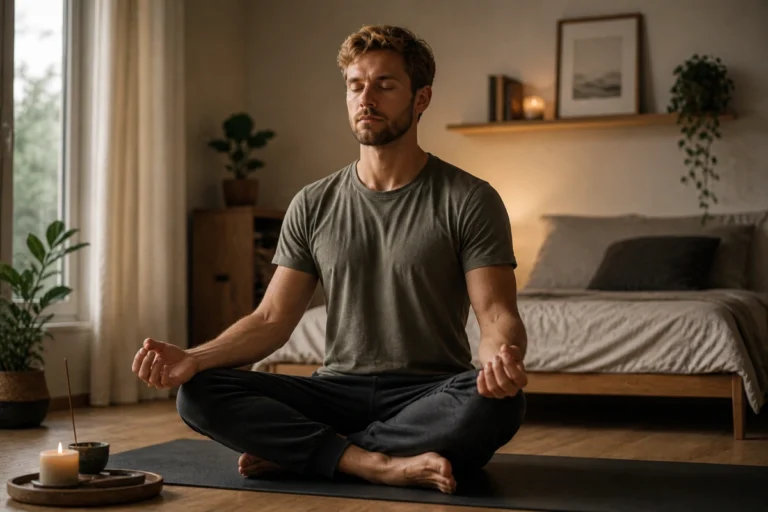
A practical way to achieve overcoming performance fear is to consciously shift attention away from outcome-based thinking. Instead of focusing on erection quality or timing, you redirect attention to sensory input. This is where mindfulness and sexual awareness techniques become incredibly valuable.
Many people find that pleasure increases not when they “try harder,” but when they stop monitoring themselves so intensely.
If you are dating later in life without experience, practicing these male sexual confidence techniques outside the bedroom, such as through meditation or somatic exercises, can make them easier to access when you are with a partner.
- Sensory Anchors:
- The rhythm of your partner’s breathing.
- The texture of the sheets or skin.
- The specific sound of the music or the room.
- The warmth of the physical connection.
🗣️ Communication Reduces Internal Pressure
One of the most overlooked tools for managing intimacy nerves is simple, calm communication. This does not mean a dramatic confession. It means honest, grounded acknowledgment. Most anxiety thrives in silence. When it is spoken about lightly and without shame, it usually shrinks.
Something as simple as saying, “I can get a bit in my head sometimes, so I want to take things slowly,” removes secrecy and lowers the perceived pressure. If you are traveling or meeting people in new environments, being upfront about your pace can actually build a stronger connection.
Learning how to talk to a partner about being a late bloomer is often the fastest way to create a safe emotional environment.
⚖️ Reframing Success and Habits
A major driver of performance anxiety male stress is a narrow definition of success. This is usually centered on a specific physical outcome. But sexual experience is far broader than that. Connection, responsiveness, and emotional safety all play a role in how satisfying an encounter feels.
Adult male sexual therapy tips often suggest expanding what “doing well” means. When physical function is no longer treated as the sole indicator of success, the pressure decreases. Ironically, physical response often improves.
| Habit | Why it Works |
| Slowing Down | Prevents the nervous system from hitting “overdrive.” |
| Discreet Breathing | Signals safety to the brain via the vagus nerve. |
| Normalizing Pauses | Breaks the expectation of a “continuous performance.” |
| Focusing on Touch | Keeps the brain anchored in the “now.” |
🏁 A Grounded Way to Look at It
If there is one thing worth holding onto, it is this: performance anxiety is not a character flaw. It is a learned stress response that shows up when something feels important and uncertain at the same time. For many men navigating a late sexual awakening, this intersection is completely expected.
It does not define your capability or your future. With time, patience, and a shift in how you relate to the moment, the pressure begins to loosen. What replaces it is not perfection. It is ease, familiarity, and a sense of sustainable sexual confidence. You are not “behind.” You are simply learning the language of your own body at your own pace.