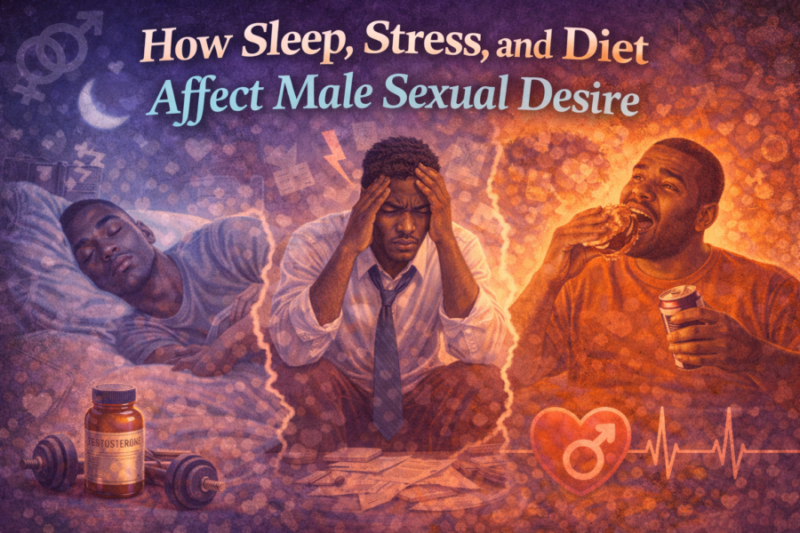
How Sleep, Stress, and Diet Affect Male Sexual Desire
TLDR
- Poor sleep is linked to lower testosterone levels and reduced sexual desire in men
- Chronic stress elevates cortisol, which can suppress libido and interfere with arousal
- Diet quality influences hormone production, vascular health, and energy levels
- Obesity and metabolic dysfunction are associated with lower testosterone and sexual interest
- Small, consistent improvements in sleep, stress management, and nutrition can meaningfully support libido
If you’ve ever wondered why your sexual desire feels inconsistent, flat, or lower than you expected, it’s tempting to search for a psychological explanation first.
But libido isn’t just about mindset.
It’s strongly influenced by physiology. Sleep patterns, stress load, and dietary habits shape hormonal balance, energy levels, and mood regulation. And those factors directly affect sexual desire.
For many men, especially those who feel like “late bloomers,” this can be surprisingly reassuring. Sometimes the issue isn’t identity or masculinity. It’s biology asking for better support.
Let’s unpack what’s actually happening.
Sleep: The Overlooked Libido Regulator
Sleep is one of the most powerful regulators of testosterone production.
In healthy men, testosterone levels follow a daily rhythm. They rise during sleep and peak in the morning. When sleep is restricted, fragmented, or chronically shortened, testosterone levels decline.
Controlled sleep restriction studies have shown that even one week of significantly reduced sleep can lower daytime testosterone levels in young healthy men. Lower testosterone is associated with reduced sexual desire.
But the impact of sleep goes beyond hormones.
Poor sleep increases fatigue, irritability, and emotional reactivity. When you’re exhausted, your brain prioritizes recovery, not reproduction. Sexual interest naturally drops when the body is under-rested.
Sleep deprivation is also linked to increased cortisol, the body’s primary stress hormone. Elevated cortisol can interfere with sexual arousal and desire.
If your libido has dipped and you’re sleeping five or six fragmented hours a night, that connection is not coincidental.
Sleep Disorders and Sexual Desire
Conditions like obstructive sleep apnea are associated with lower testosterone levels and higher rates of sexual dysfunction.
Sleep apnea reduces oxygen levels during the night and disrupts restorative sleep cycles. Studies show that treating sleep apnea, particularly with continuous positive airway pressure therapy, can improve sexual function in many men.
This is not a niche issue. Sleep apnea is common, especially in men who are overweight or middle-aged.
If you snore heavily, wake up unrefreshed, or feel persistently fatigued despite adequate time in bed, it may be worth discussing with a healthcare provider.
Libido often improves when sleep quality improves.
Stress: Cortisol and the Suppression of Desire
Stress has a clear biological footprint.
When you experience chronic stress, your body produces more cortisol. In short bursts, cortisol is useful. Chronically elevated, it disrupts hormonal balance.
High cortisol levels can suppress the hypothalamic-pituitary-gonadal axis, which regulates testosterone production. Lower testosterone can contribute to decreased libido.
Stress also shifts attention. When your mind is preoccupied with financial pressure, job instability, family conflict, or chronic worry, mental bandwidth for sexual interest shrinks.
There’s also a vascular component. Stress can impair blood vessel function, which affects erectile quality. While desire and performance are distinct, they influence each other.
When erections become inconsistent, anxiety increases. Anxiety further suppresses desire. It becomes a feedback loop.
Psychological Stress Versus Acute Stress
It’s important to distinguish between acute stress and chronic stress.
Short-term stress does not necessarily eliminate sexual desire. In some contexts, adrenaline can even increase arousal.
But prolonged psychological stress, especially when paired with poor sleep, tends to dampen libido.
Men who report burnout, emotional exhaustion, or persistent anxiety often describe a parallel decline in sexual interest. This pattern is widely documented in research on occupational stress and sexual function.
Addressing stress is not a luxury. It’s part of maintaining sexual health.
Diet and Hormonal Health
Hormone production depends on adequate nutrition.
Testosterone is synthesized from cholesterol. Extremely low-fat diets can reduce testosterone levels in some men. Balanced dietary fat intake supports normal endocrine function.
Micronutrients also matter. Zinc deficiency is associated with reduced testosterone levels. Severe calorie restriction can suppress reproductive hormones.
Energy availability signals safety to the body. When calorie intake is chronically insufficient, the body may downregulate reproductive function as a protective mechanism.
On the other end of the spectrum, obesity is associated with lower testosterone levels.
Excess adipose tissue increases the activity of aromatase, an enzyme that converts testosterone into estradiol. Higher estradiol levels in men can suppress further testosterone production.
Weight loss in men with obesity has been shown to increase testosterone levels and improve sexual function.
Metabolic Health and Libido
Insulin resistance and type 2 diabetes are associated with lower testosterone levels and higher rates of sexual dysfunction.
Metabolic dysfunction affects vascular health, nerve function, and hormonal balance. All three influence sexual desire and performance.
Improving diet quality, increasing fiber intake, moderating added sugars, and supporting stable blood glucose levels can improve metabolic markers.
As metabolic health improves, hormonal balance often improves as well.
This is not about perfection. It’s about direction.
Alcohol, Diet, and Sexual Interest
Alcohol deserves a brief mention.
Acute alcohol consumption may reduce inhibitions, but excessive or chronic use is associated with reduced testosterone levels and sexual dysfunction.
Alcohol can disrupt sleep architecture, increase cortisol, and impair liver function, which plays a role in hormone metabolism.
Moderation matters if libido is a concern.
The Combined Effect: When Factors Stack
Sleep deprivation, chronic stress, and poor diet rarely occur in isolation.
They tend to cluster.
You sleep poorly because you’re stressed. You eat poorly because you’re tired. You feel more stressed because your blood sugar is unstable and your sleep is fragmented.
Over time, testosterone declines, energy drops, and sexual desire follows.
The encouraging part is that small improvements in one area often spill into others.
Better sleep improves stress tolerance. Improved diet stabilizes energy. Lower stress enhances sleep quality.
Libido often rises gradually as the system stabilizes.
A Practical Perspective
I’ve noticed that many men assume libido is either present or broken.
In reality, it’s dynamic.
When sleep improves from five hours to seven, when stress is managed more intentionally, when nutrition becomes more balanced, desire often returns without dramatic intervention.
It doesn’t usually happen overnight. It builds.
You may not wake up suddenly transformed, but you may notice more spontaneous interest, more consistent arousal, more mental space for intimacy.
And that’s meaningful.
What You Can Control
You cannot eliminate all stress. You cannot control every hormonal fluctuation.
But you can aim for consistent sleep duration, ideally seven to nine hours for most adults. You can reduce screen exposure late at night. You can prioritize nutrient-dense meals over ultra-processed patterns most days.
You can also evaluate chronic stressors and consider practical adjustments, whether that’s workload boundaries, therapy, exercise, or relaxation techniques.
These are not cosmetic changes. They are foundational.
Sexual desire is part of overall health. When your body feels safe, rested, and nourished, libido tends to reflect that.
Conclusion
Male sexual desire is shaped by biology as much as psychology.
Sleep supports testosterone production and emotional stability. Chronic stress elevates cortisol and can suppress libido. Diet influences hormone synthesis, metabolic health, and vascular function.
If your desire feels lower than you’d like, start with the fundamentals.
Improve sleep quality. Reduce chronic stress where possible. Support your body with balanced nutrition.
These adjustments are not dramatic. They are steady.
And steady, in the context of late sexual awakening, is powerful.