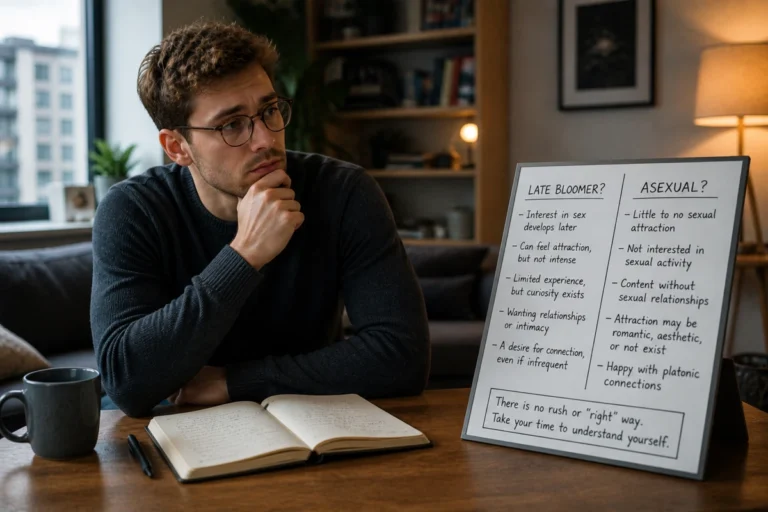

🚀 Why Sexual Confidence Develops Later for Some Men

TLDR
- Not a Birthday Gift: Sexual confidence is shaped by personality, upbringing, and environment, not a fixed age.
- The Anxiety Gap: Men with high introversion or anxiety often begin exploration later.
- Internalized Messaging: Shame-based environments can delay comfort with sexuality into late adulthood.
- Brain Plasticity: Sexual skills are learned through experience and remain fully adaptable in your 20s, 30s, and beyond.
- Awareness vs. Pressure: Later starters often build deeper confidence because it is rooted in internal alignment rather than peer pressure.
If you’ve ever felt like everyone else received a “starter pack” for dating in high school while you were still figuring out algebra, you’re not alone. Sexual confidence doesn’t emerge on a fixed timeline. It develops through exposure, emotional safety, feedback, and repetition.
For some men, those conditions show up early. For others, they don’t manifest until much later. That delayed sexual confidence isn’t random; it follows very understandable psychological and social patterns. Let’s unpack what actually influences the timing of adult sexual growth.
🧠 Personality: The Silent Timeline Driver
Temperament shapes social behavior from early adolescence onward. Men who are naturally introverted or cautious tend to approach risk differently than their sensation-seeking peers. Dating and early sexual experiences require a high tolerance for rejection and vulnerability.
If your nervous system is wired to perceive social threats more intensely, your threshold for action is simply higher. Research in personality psychology shows that traits like neuroticism are often linked to psychological barriers to sexual expression. Development slows because the stress response is more active, not because the man is incapable.
The Personality & Development Matrix
| Trait Type | Impact on Social Approach | Effect on Sexual Confidence |
| High Introversion | Prefers deep, one-on-one connection | May delay casual “group-based” dating |
| High Social Anxiety | Avoids situations involving evaluation | Can lead to delayed sexual self-assurance |
| Cautiousness | High focus on safety and consequences | Leads to sequencing life goals before intimacy |
🏠 Upbringing and the Weight of Shame
Sexual confidence is strongly shaped by early messaging. Families and communities vary widely in how they talk about desire. Men raised in environments where sexuality was framed primarily as risky, sinful, or shameful often internalize an intense caution. This internal tension is one of the primary factors for late sexual confidence.
Shame doesn’t eliminate interest, but it complicates it significantly. Many find that how early life conditioning shapes behavior persists long after they’ve moved away from home. For these men, confidence only develops after they consciously separate inherited beliefs from personal values, a process that usually happens during independent adulthood.
💡 Expert Tip: The De-Shaming Process
Recognize that “internalized shame” is not a personality trait; it is an external voice you’ve adopted. Identifying it as something you learned means it is something you can unlearn.
📉 The Impact of Physical & Social Environments
Puberty does not unfold at the same pace for everyone. Male libido development and the confidence that follows can be stalled by late physical maturation.
- Physical Timing: Boys who mature later often report lower social status in high school. While biology evens out, the psychological imprint can lead to breaking an “I’m behind” narrative much later in life.
- Environmental Logistics: Small schools, isolated communities, or male-dominated programs (like engineering) limit exposure.
- Logistics vs. Pathology: If you didn’t have opportunities, your development didn’t fail; it simply paused. When you move or join best dating apps for beginners, development often accelerates.
🩺 Mental Health and Social Anxiety
Anxiety disorders and depression frequently begin in adolescence and are associated with reduced social engagement. Social anxiety, in particular, has a clear relationship with delayed sexual confidence. The fear of negative evaluation makes initiating intimacy feel disproportionately risky.
The encouraging part is that anxiety is highly treatable. As mental health improves, adult male libido self-esteem often follows. It is not a separate trait; it is downstream from emotional regulation and finding emotional safety.
📝 Growth Note: Beyond Biology
While some worry about testosterone levels, the “mental brakes” are usually more powerful than the “hormonal gas pedal.” Addressing the mind is often more effective than supplements.
🚀 Building Sexual Confidence After 25
There is a widespread cultural narrative that “real men” become sexually active early. This belief creates immense pressure, but large-scale surveys show a substantial minority of men begin their journey in their twenties or thirties.
Adult sexual growth is actually more efficient because adults are better at reflection and communication than teenagers. Psychological reasons for delayed sexual self-assurance often dissolve when you realize your brain remains plastic. You can learn the “skills” of intimacy at any age through gradual exposure and experience.
Why Later Confidence is Often Stronger
- Internal Alignment: You aren’t performing for peer approval; you are acting on personal values.
- Communication Skills: Older men are typically better at talking to partners about being a late bloomer.
- Steadier Foundations: You are less likely to rush into impulsive, unhealthy pairings just to “prove” something.
📊 Statistics on Development Timing
While society presents a narrow view of development, the data shows a different story of variation across different demographics:
- Age Variation: Research suggests approximately 10% to 15% of men in Western societies remain sexually inexperienced into their early to mid-20s.
- Racial & Cultural Factors: Studies in the US have shown that Asian American men sometimes report later ages of first sexual activity compared to other racial groups (approximately 18.5 years on average vs 16.8 for Black American men), often citing a heavier focus on academic achievement and cultural family values during adolescence.
- Education: Men who pursue higher levels of education (Masters/PhD) often show a statistically significant delay in their first romantic relationship compared to those who enter the workforce at 18.
🎯 What Actually Helps Confidence Grow?
Men developing sexual confidence late succeed by following a consistent mechanism:
- Gradual Exposure: Moving from starting to date to physical closeness at a manageable pace.
- Accurate Information: Learning that late blooming is normal.
- Physical Awareness: Using somatic practices to reconnect with body sensations.
- Consistency: Building sustainable confidence through repeated, honest effort.
🏁 Conclusion
Delayed sexual confidence occurs because the specific conditions you needed—emotional safety, the right environment, or mental health support—arrived later than expected. Human development is flexible. The nervous system adapts, skills are learned, and beliefs evolve.
If your journey is unfolding now, that doesn’t mean you are defective. It simply means your growth began when your circumstances finally allowed it to. Different is not broken; it’s just a different path to the same destination.