Late Sexual Awakening vs Low Libido: How to Tell the Difference

Key Take-Aways
- Late sexual awakening centers on a delay in timing and experience rather than a lack of drive. You want to fuck, but for some reason it’s not happening.
- Low libido is a biological or psychological reduction in the actual desire for sexual activity.
- Physical arousal remains biologically possible for late bloomers but often feels blocked by anxiety.

Are you a late bloomer, or do you just have a low libido?
It is surprisingly common to mix these two up when evaluating your own journey.
If your sexual life hasn’t developed the way you expected, it is easy to assume something is fundamentally wrong with your desire.
You might wonder if you simply have low libido, or if you have somehow missed your window to develop sexually.
However, these are two very different situations. Understanding the late sexual awakening vs low libido distinction can take a huge amount of pressure off your shoulders.
It helps you respond to what is actually happening in your body and mind, instead of guessing and second-guessing yourself. Gain libido clarity by looking at the specific markers of your experience.
It’s really not that complicated, and in this short article I’ll explain the differences between late sexual awakening vs low libido.
What Is a Late Sexual Awakening?
A late sexual awakening refers to a delay in sexual experience, development, or expression compared to what is considered socially typical.
That’s a pretty broad term, but many men already feel behind if they haven’t hit certain milestones by their early 20s – I certainly did!
This delay does not mean your body isn’t capable of arousal, nor does it mean your desire is absent.
However, it COULD mean one or both of those, for example if you’ve been watching too much porn for many years, you might physically not be capable of arousal with a real woman until you rewire your brain.
It usually means that the specific conditions required for sexual development weren’t in place during your younger years.
When distinguishing sexual desire issues, look at whether you feel a drive that simply has nowhere to go.
In many cases, a late sexual awakening means the underlying capacity for sexual interest is entirely intact. It just hasn’t been explored or expressed fully yet.
Read also: Why Some Men Experience Sexual Awakening After 25
What Is Low Libido?
Low libido on the other hand refers to a reduced or absent interest in sexual activity. This is not about timing or blooming late, it’s about the internal drive itself.
For men, this can be a complex issue involving both the mind and the body.
A person with low libido may rarely think about sex, feel little to no interest in pursuing sexual activity, and fail to respond strongly to sexual cues or stimulation.
It’s often related to low testosterone.
When diagnosing adult male libido issues, doctors often look for persistent patterns rather than temporary dips.
According to research archived by the National Institutes of Health (NIH), low libido can be categorized as either generalized (a total lack of desire) or situational (desire exists but not for a specific partner).
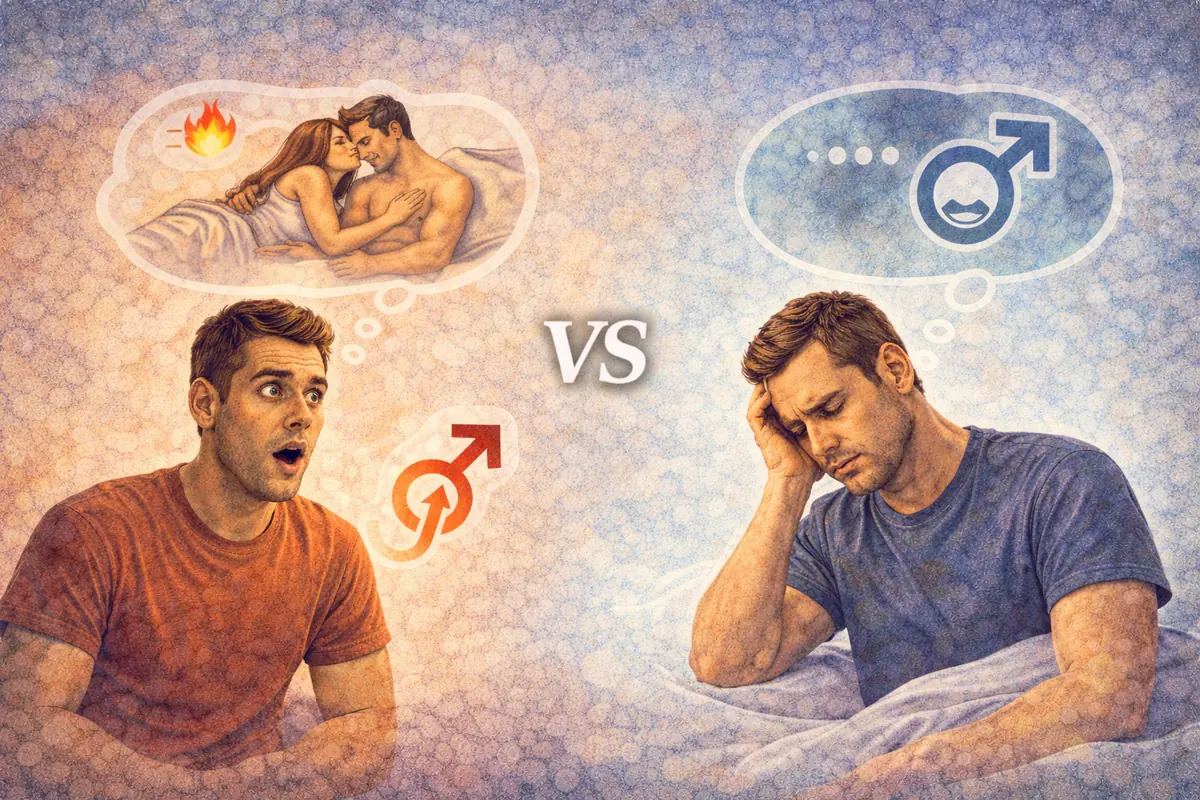
Comparison: Late Awakening vs. Low Libido
| Feature | Late Sexual Awakening | Low Libido |
| Primary Issue | Lack of experience and opportunity | Lack of internal desire and drive |
| Physical Response | Usually present (erections and arousal) | Often reduced or inconsistent |
| Mental State | Curious but anxious or blocked | Neutral, indifferent, or uninterested |
| Root Cause | Psychological, social, and environmental | Hormonal, physical, and medical |
| Core Feeling | I want to, but I do not know how. | I do not really feel the need to. |
The Role of Curiosity
One of the simplest ways to understand the difference between delayed sexual awakening and low libido is to measure your level of curiosity.
If you feel curious about sex, intimacy, or connection, but you just haven’t gotten around to it yet for whatever reason, that points more toward a late awakening than low libido.
Curiosity might show up as:
- Being horny.
- An interest in learning about sex.
- Wondering what specific physical experiences feel like.
- Feeling drawn to the idea of sex, even if the execution feels terrifying.
Low libido tends to lack that magnetic pull.
The topic itself may feel neutral or even uninteresting rather than confusing or intimidating.
Focusing on this curiosity provides understanding late male sexual desire in a way that clinical definitions sometimes miss.
Read also: Is It Normal to Discover Sexual Desire Later in Life?
How Your Body Responds
The next important distinction lies in physical response. Do you get aroused?
Men experiencing a late sexual awakening typically still have the biological capacity for arousal.
Given the right conditions, usually involving safety and a lack of pressure, their bodies respond. This includes experiencing spontaneous erections or responding to touch.
However, and this is a massive issue these days, porn addiction can SEVERELY cause problems, mental and physical. I’ve been there.
It takes a long time to rewire your brain in order to allow your body to respond appropriately again to real women, instead of those on a screen.
With low libido, the physical response is often the first thing to fade. Even in traditionally arousing situations, the body may feel unresponsive.
However, the two aren’t completely separate. High levels of stress can temporarily mimic low libido by triggering the body’s fight or flight response, which shuts down non-essential functions like sexual drive.
If you’re interested about the biological side, it is helpful to understand does testosterone really decline in your 20s and 30s and how that impacts your baseline drive.
Stress, Health, and Lifestyle
Low libido is frequently the canary in the coal mine for your overall male sexual health. If your desire has vanished, it may be due to chronic stress, poor sleep, or underlying medical conditions.
- Cortisol Overload: High stress from work or finances kills testosterone.
- Sleep Deprivation: The majority of male hormone production occurs during deep sleep.
- Sedentary Lifestyle: Poor blood flow directly impacts physical responsiveness.
- Nutritional Gaps: Diets high in processed sugar can lead to systemic inflammation and lower drive.
If your energy levels are consistently low across all areas of life, your lack of sexual interest is likely a symptom of a larger lifestyle issue. These are critical factors when diagnosing adult male libido issues.
Read also: How Sleep, Stress, and Diet Affect Male Sexual Desire
Questions to Help You Tell the Difference
If you are still unsure where you land on the spectrum, ask yourself these three direct questions:
- Do I feel interested in sex but blocked by fear, shame, or a lack of knowledge? (Points to Late Awakening)
- Do I experience arousal when I am alone, relaxed, or not under pressure to perform? (Points to Late Awakening)
- Has my desire been high in the past and recently disappeared alongside health or life changes? (Points to Low Libido)
In summation, late sexual awakening and low libido may look similar on the surface, but they come from entirely different places.
By paying attention to your curiosity and your body’s physical responses, you can stop guessing in the dark.
Whether you are a late bloomer or someone dealing with a temporary dip in drive, there is a clear path forward.
If you’ve got a low libido, I’d suggest you get your blood tested and a psychological evaluation to determine what’s causing it – and taking action accordingly. It’s almost always treatable, but you do need to take action.
For late bloomers, I’d recommend making an account on some sex dating sites and getting sexual experience, which will rapidly lead to improvements in the rest of your life.