
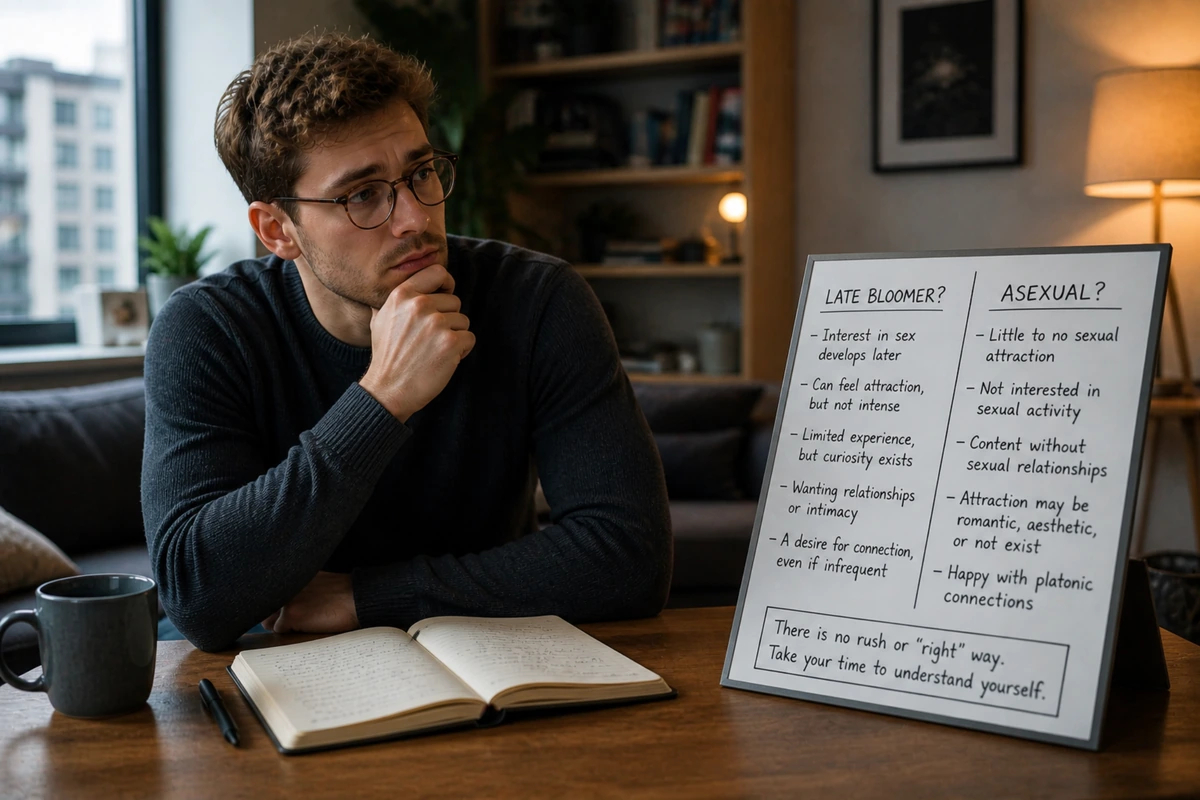
🔦How to Know If You Are a Late Bloomer or Asexual

TLDR
- Core Definitions: Asexuality is a consistent lack of sexual attraction, while late blooming involves delayed development rather than absence.
- Conditional Attraction: If attraction appears under specific conditions or develops over time, you are likely a late bloomer rather than asexual.
- Suppression Factors: Anxiety, low confidence, and a lack of experience can suppress or delay sexual feelings.
- Orientation Stability: Asexuality is a stable orientation, not something typically caused by inexperience or fear.
- Clarity Through Time: Understanding your patterns over time, not just in one isolated moment, is the key to clarity.
This is a question that tends to show up quietly and then stick around for the long haul. You notice that your experiences don’t quite match what you hear from other people. Maybe you don’t feel strong sexual attraction, or perhaps your interest is inconsistent, delayed, or tied to very specific situations.
At some point, the question comes up: Is this just part of your unique adult sexual development, or is it something else entirely?
It’s a fair question and it deserves a calm, honest answer without jumping to conclusions. The short version is that being a late bloomer and being asexual are not the same thing. But from the inside, especially if you don’t have much experience, they can feel surprisingly similar.
💡 Expert Tip: Avoid the Comparison Trap
Many men assume they are asexual because they don’t match the “hyper-sexual” stereotype often seen in media. True male sexual identity is a broad spectrum, and your starting point does not dictate your destination.
🔎 What Asexuality Actually Means
Asexuality is defined as experiencing little to no sexual attraction to others. This does not mean a lack of emotions, connection, or even romantic interest. Many asexual people still want relationships, intimacy, and companionship. The key distinction is that sexual attraction itself is absent or minimal over time.
Patterns in Asexual Orientation
- Consistency: The lack of attraction is typically stable across different environments and stages of life.
- Independence from Anxiety: Attraction remains absent even when the individual feels confident and relaxed.
- Emotional Focus: Interest in relationships is purely emotional or romantic without a desire for sexual interaction.
- Long-Term Stability: It is considered a stable orientation rather than a temporary phase.
If you consistently don’t feel sexual attraction across different situations, over a long period, and without it changing as your life circumstances change, that leans more toward asexuality. This is the foundation of distinguishing asexuality late onset from other experiences.
🛡️ What Being a Late Bloomer Looks Like
A late bloomer does experience attraction, but it shows up later, more gradually, or under specific conditions. This can happen for many reasons. Some men don’t have early romantic or sexual experiences, so their brains don’t develop the same immediate response patterns. Others deal with anxiety, self-consciousness, or low confidence that dampens their natural reactions.
Adult Sexual Development Factors
| Factor | Description | Influence on Desire |
| Delayed Experience | Lack of early dating or romantic interactions. | Brain lacks immediate response patterns. |
| Anxiety | High levels of performance or social stress. | Mutes natural instinctive reactions. |
| Self-Consciousness | Excessive focus on how one is perceived. | Prevents getting “out of your head.” |
| Low Confidence | Belief that one is “behind” peers. | Can cause a total shutdown of desire. |
In these cases, attraction isn’t absent. It’s just delayed or muted. Once these factors change, the underlying attraction often becomes a lot clearer. This is a common path for those navigating what is late sexual awakening in men.
🌓 The Key Difference: Absence vs. Suppression
This is the most important distinction to understand. Asexuality is about absence. Late blooming is usually about suppression or delay. If something is being suppressed, it tends to show up under the right conditions. If it’s absent, it generally doesn’t appear regardless of the situation.
Questions to Ask Yourself
- Have I ever felt attraction, even briefly, under certain conditions?
- Does attraction show up only when I feel completely safe and relaxed?
- Is my interest tied to how much emotional safety I feel with a partner?
- Do I feel desire once I know someone is genuinely interested in me?
The answer to these questions tells you a lot about whether you are dealing with a fixed orientation or a psychological barrier to sexual expression.
🧩 Situations Where Confusion Happens
There are common scenarios where men often mistake their signs of being a late bloomer for asexuality. Because the feeling of “nothing” is so prominent, it’s easy to assume that “nothing” is the permanent state.
The “Safe Zone” Attraction
If you notice that attraction shows up after you’ve gotten to know someone, or when you feel relaxed and safe, that points toward late blooming. Sexual desire is heavily influenced by emotional and psychological comfort. When those are missing, attraction can feel absent.
The Validation Spark
If your attraction increases when you feel chosen or validated, it suggests your desire is tied to confidence and security. This is a pattern many men with dating later in life without experience encounter.
Read Also: Why Some Men Don’t Discover Desire Until Emotional Safety Exists
🚀 Why Inexperience Complicates Everything
If you haven’t had many interactions, it’s harder to interpret your own reactions because you don’t have enough data. Imagine trying to figure out your taste in food after only trying a handful of dishes, all in stressful situations. You wouldn’t know if you dislike the food or if you just haven’t experienced it properly yet.
The Lack of Data Loop
- Limited Exposure: Few varied interactions with potential partners.
- Stressful Context: Initial experiences are often high-pressure.
- Controlled Mode: The brain stays in an evaluative, “safety-first” mode.
- Muted Instincts: Natural attraction is blocked by the need to “do things right”.
Without enough varied experiences, including different people and contexts, it’s easy to draw conclusions that aren’t fully accurate. This is why is it normal to discover sexual desire later in life is such a frequent question.
🧘 The Role of Anxiety and Self-Perception
Anxiety doesn’t just affect behavior; it affects perception. When you’re tense or self-conscious, your brain shifts into a more controlled, evaluative mode. This makes it harder to feel instinctive reactions like attraction.
Understanding the “Muting” Effect
- Risk Avoidance: If you deal with low confidence, your mind may block attraction to avoid the risk of rejection.
- Self-Monitoring: Constantly checking your reactions prevents you from actually having them.
- Early Conditioning: How early life conditioning shapes adult behavior can create a long-term habit of suppression.
This doesn’t mean the underlying capacity isn’t there. It often just means you need to navigate the role of anxiety in delayed sexual expression before your natural responses can surface.
🏁 Approach Without Rushing to Label Yourself
It’s tempting to look for a clear label because it feels like it would simplify things. But in the adult male sexual identity guide, rushing that decision can actually create more confusion. A more useful approach is to observe your patterns over time.
Practical Observation Steps
- Note the Hints: Pay attention to when you feel even a hint of attraction and what the environment was like.
- Observe Shifts: Notice if your responses change as you gain more experience or reduce anxiety.
- Gain Social Comfort: Spend time around people without pressure to see how your body reacts naturally.
- Stay Curious: Approach your responses with curiosity rather than judgment.
If things shift, even gradually, that’s meaningful information. You might find that why sexual confidence develops later for some men is a major key to your journey.
🛠️ A Grounded Way to Move Forward
Instead of focusing on classification, focus on experience. Build social comfort and let interactions develop naturally. Reduce the conditions that suppress your reactions, such as stress, overthinking, and constant self-monitoring.
Growth Strategies for Late Bloomers
| Strategy | Focus Area | Goal |
| Mindfulness | Mental state during dates. | Staying present in the body. |
| Somatic Practice | Reconnecting with sensation. | Reducing the “heady” disconnect. |
| Social Exposure | Low-stakes interactions. | Building general comfort around others. |
| Therapy | Unpacking past baggage. | Resolving suppression causes. |
Working through breaking the “I’m behind” narrative is often the first step toward genuine discovery.
🏁 Conclusion
The difference between the late bloomer vs asexual experience comes down to whether attraction is fundamentally absent or simply delayed. For many men with limited experience, what feels like absence is actually a combination of anxiety and unfamiliarity.
Once those factors shift, attraction often becomes easier to recognize. At the same time, asexuality is a valid and well-established orientation. The only way to tell the difference is by observing your own patterns honestly and without pressure. You are not behind; you are just still learning how your own system works. That clarity becomes much sharper with time and experience.
Read Also: The Complete Guide to Late Sexual Awakening in Men